Marine Equipment & Systems

Dual-Fuel Gas Supply Unit Integration System

Integrate fuel storage/take-off, pressure conditioning, vaporisation, valve train, safety and automation around the dual-fuel engine gas interface

Selected capability

Dual-Fuel Gas Supply Unit Integration System

Integrate fuel storage/take-off, pressure conditioning, vaporisation, valve train, safety and automation around the dual-fuel engine gas interface

An integrated fuel-gas-supply scope for LNG/natural-gas dual-fuel main engines or generating sets. The system is engineered around the engine-required gas pressure, temperature, flow and dynamic load range, coordinating fuel storage or cargo-system interfaces, pumping/pressurisation, vaporisation/heating, gas valve unit/train, BOG handling where applicable, ventilation, gas detection, ESD and vessel automation. Other fuel media require a separately defined process and safety boundary.

01Bring fuel-supply equipment, engine interfaces, ship safety systems and onboard piping into one engineering boundary to reduce interface gaps
02Verify pressure, temperature, flow and control range against actual engine load transients instead of selecting only at a static rated point
03Define ESD, gas detection, ventilation, alarms and IAS/FCS interfaces during engineering for smoother class review and commissioning
Discuss this project
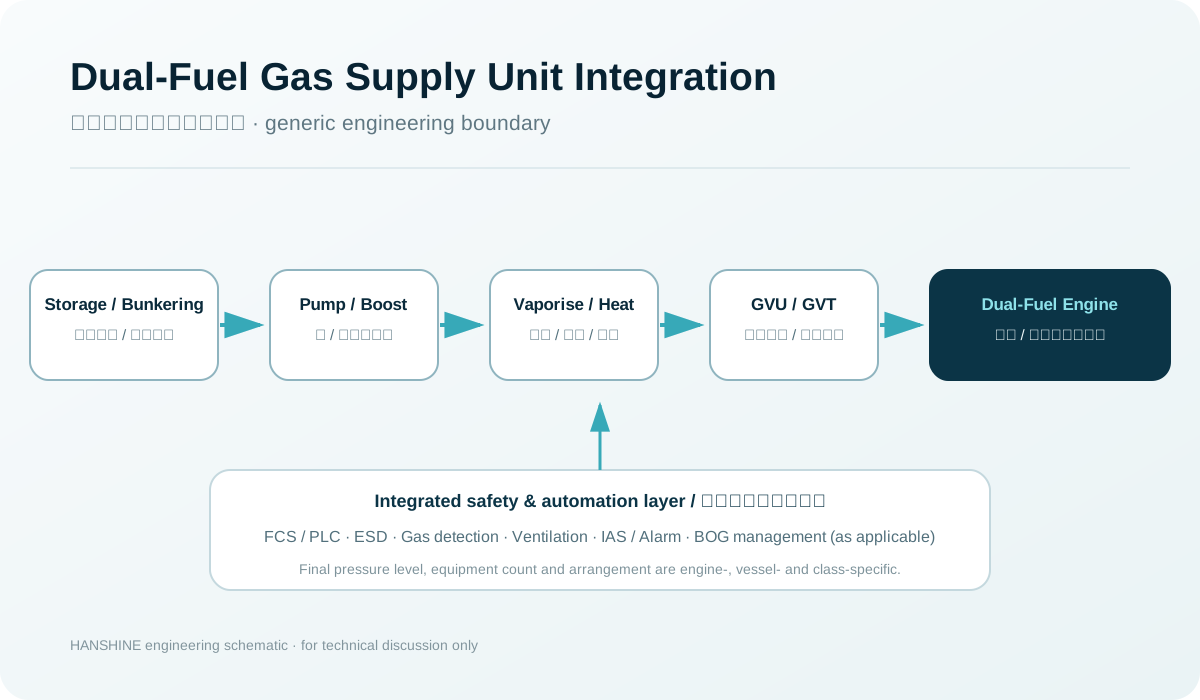
Dual-Fuel Gas Supply Unit Integration System schematic
Technical principle / system relationship
System relationship

Make the interfaces clear before equipment selection.

This flow is a quick view of the system boundary. Final quantities, interfaces and configuration remain vessel- and project-specific.

01Storage / Bunkering
02Pump & pressure
03Vaporise & condition
04GVU / GVT
05DF engine + ESD/IAS
01

Typical configuration & scope

  • Fuel-tank/cargo-system take-off, bunkering station and associated valves as defined by project scope
  • Low- or high-pressure pumping/boosting and pressure regulation, with pressure level determined by engine technology
  • Vaporisers, heaters, filtration/conditioning and BOG handling equipment where required
  • GVU/GVT gas valve train plus ventilated/double-wall piping and vent interfaces where required by the applicable rules and arrangement
  • Fuel Control System (FCS)/PLC, ESD, gas detection, ventilation and IAS/alarm-system interfaces
02

Information required

  • Engine maker/model and required gas inlet pressure, temperature, flow, minimum load and transient response
  • Fuel medium/composition, fuel-tank or cargo-system arrangement, bunkering concept and BOG-management requirement
  • GA, machinery/fuel-space arrangement, P&ID, hazardous-area plan and available installation space/weight
  • Power, heating/cooling media, ventilation, vent/drain and control/communication interfaces
  • Class/flag requirements, redundancy/availability target and approval scope
03

Engineering focus

  • Low- or high-pressure architecture and supply pressure/temperature must match the specific engine-maker interface; there is no single universal setpoint
  • Verify supply stability, buffer capacity, redundancy and gas/liquid-fuel changeover logic during rapid main-engine or genset load changes
  • Treat hazardous areas, ventilation, leak detection, ESD, venting and Ex electrical equipment as one coordinated safety philosophy
  • For LNG projects, define the BOG route against tank type and operating profile; gas carriers also require a clear integration boundary with the existing cargo system
  • Arrangement must allow maintenance access and account for cryogenic/high-pressure piping expansion, vibration, insulation and class approval
04

Standards & technical basis

  • IMO IGF Code for ships using gases or other low-flashpoint fuels as fuel, as applicable
  • Class / flag-state rules for gas-fuelled ship installations
  • Engine-maker FGSS / GVU / GVT interface specifications
  • IMO IGC Code where integration with a liquefied-gas cargo system is applicable

Applicable rules, certificates and approval scope are confirmed against vessel class, flag and contract requirements.

From data to delivery

One delivery logic, with engineering depth adapted to each capability.

  1. 01Define duty & constraints
  2. 02Engineering / selection / interfaces
  3. 03Manufacturing / sourcing / approvals
  4. 04Installation / commissioning / verification
  5. 05Handover / lifecycle support