Marine Equipment & Systems

Liquefied Gas Monitoring

Continuously monitor hazardous gases and integrate alarms, interlocks and records into ship safety systems

Selected capability

Liquefied Gas Monitoring

Continuously monitor hazardous gases and integrate alarms, interlocks and records into ship safety systems

Combines fixed detectors, extractive sampling, portable instruments and central alarm units according to compartment risk. Target gases may include combustible gas, O₂, H₂S, CO and CO₂; sensor technology and detector location must be selected for the actual hazard.

01Turn local gas hazards into monitored, alarmed and logged signals
02Support audible/visual alarm, remote indication and ESD/IAS interlocks
03Select sensors and sampling method to cargo/fuel/space hazards
Discuss this project
Liquefied Gas Monitoring schematic
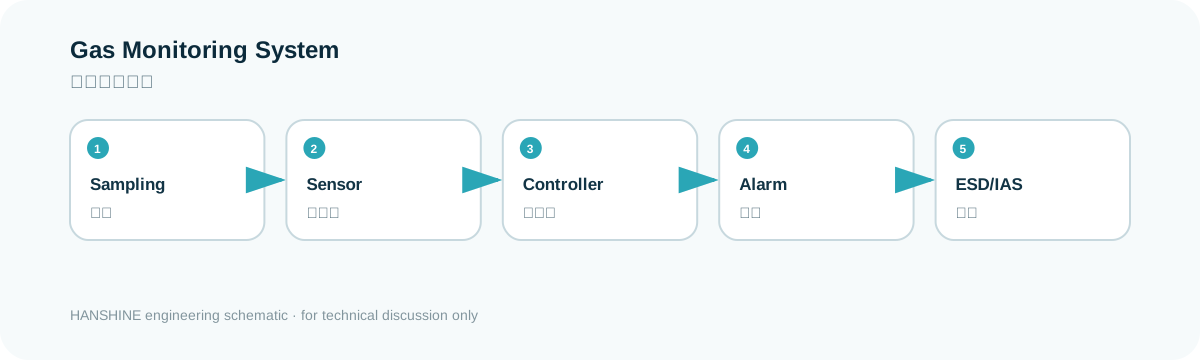
Technical principle / system relationship
System relationship

Make the interfaces clear before equipment selection.

This flow is a quick view of the system boundary. Final quantities, interfaces and configuration remain vessel- and project-specific.

01Sampling
02Sensor
03Controller
04Alarm
05ESD/IAS
01

Typical configuration & scope

  • Fixed point detectors
  • Extractive sampling cabinet and tubing
  • Alarm controller / remote display
  • Portable instruments and calibration accessories
02

Information required

  • Vessel type and hazardous-area plan
  • Target gases, ranges and alarm setpoints
  • Ex-area and certification requirement
  • IAS/ESD interfaces, power and communication
03

Engineering focus

  • Sampling delay, condensation and tubing material affect readings
  • Detector location must consider gas density and ventilation
  • Define calibration gas, maintenance interval and test method at handover
04

Standards & technical basis

  • IEC 60079 for Ex equipment where applicable
  • Class / SOLAS requirements depending application

Applicable rules, certificates and approval scope are confirmed against vessel class, flag and contract requirements.

From data to delivery

One delivery logic, with engineering depth adapted to each capability.

  1. 01Define duty & constraints
  2. 02Engineering / selection / interfaces
  3. 03Manufacturing / sourcing / approvals
  4. 04Installation / commissioning / verification
  5. 05Handover / lifecycle support